VCs are kind of like squirrels. They get very excited about something, go a little crazy, and then move on very, very quickly. A few months ago, AI enabled services were all-the-rage but it feels like the hype has faded somewhat. Maybe it’s due to other AI companies growing so quickly or perhaps it’s because the modern zeitgeist moves so quickly that it’s impossible to linger on a topic for more than a few weeks.
When we started Novella in early 2024, we had a thesis. Injecting purpose trained AI into traditional service businesses would lead to order-of-magnitude level efficiency gains. The second part of that thesis was that value would accrue not to the technology vendor but to the new service providers built natively around AI.
The rationale is simple. If AI is going to be as disruptive as we believe it will, the organizational changes required from an incumbent would be impossible to effectuate. These changes wouldn’t come from buying a new SaaS tool but from building an entirely new organization from the ground up.
We set out to build this new kind of services company, where we build almost all traditional software in house and train AI tools to do exactly what we need. We would hire a small team of domain experts and use AI to superpower them.
Meeting with investors for our first round in Q1 of 2024, the idea felt novel. And then, over the following months, VCs wrote blog post after blog post anointing AI enabled services as the next darling of venture investors. It felt good to be a few months ahead of the trend and validating that we were on the right path.
But as quickly as AI enabled services were in vogue, they were out. Tech-Twitter moved on to the likes of Cursor, Base 44, Lovable, Icon and other companies showing growth curves we’ve never seen before.
But with all the hype — and unhype — around this category, it feels timely to dive into what does an AI enabled services company look like? What makes them unique and different? And what’s it like to build one?
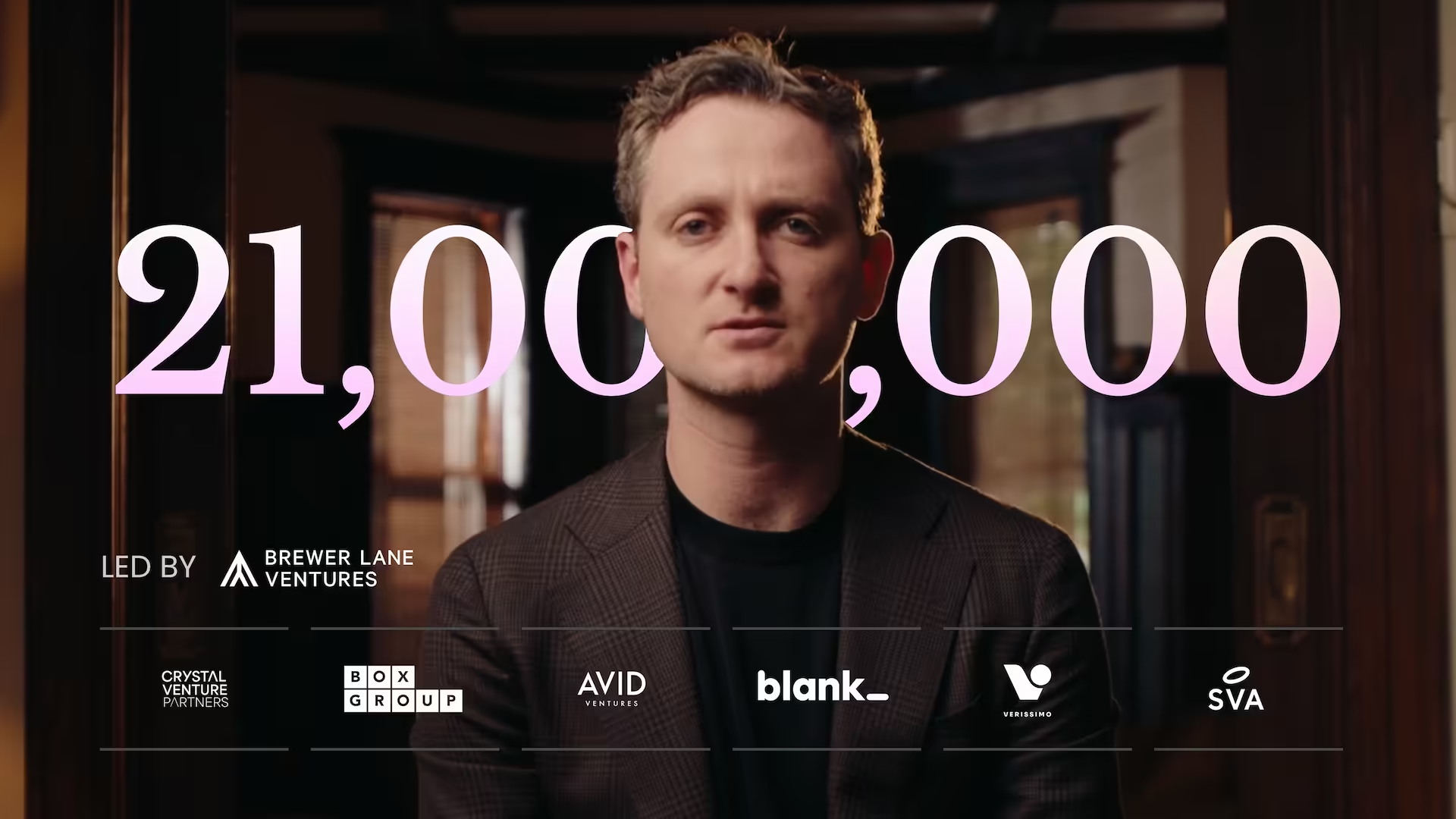
In this post, I’ll go through our thesis, what we’ve done and how we think about building the next billion dollar AI services company — a specialty insurance brokerage. This post will be the first of a series where we dive into the details of building an AI enabled service company, breaking down everything from R&D, organizational structure, financial statement construction and more. Follow along if you’re interested.
Meet Novella
At Novella, we’re building the first AI native insurance wholesaler. In insurance, wholesalers help brokers find coverage for their high-risk, hard to insure customers. When a broker has an account they’re struggling to find coverage for, they come to us. We work with insurance carriers that specialize in writing high-risk business. We act as a specialty broker for the traditional broker helping them find coverage for their most complicated customers.
Over the last 5 years, things like climate change, inflation and a challenging political environment in the United States have made assets that were once easy to insure, much harder to underwrite. Not a month goes by without some major story about how difficult it is to get insurance in Florida or California. But the problem isn’t unique to those states, it’s happening everywhere.
A high risk customer could be a large property on the coast where flooding or inclement weather has become more prevalent in recent years; a contractor working on large new projects where ambulance chasing lawyers have made lawsuits much more common. Businesses need insurance and many of them have become much more difficult to underwrite in recent years. Novella is helping people protect those businesses.
Insurance wholesaling is not new, it’s been around for decades. Until now though, it’s been an entirely human driven service without any technology. Ryan Specialty (NYSE: RYAN) does not even have an R&D expense item on their P&L. They do, however, pay out 57% of revenue in employee compensation. As is standard with traditional services businesses, they don’t invest in technology but rather expect people to manually get things done.
Until AI, specifically large language models, this made sense. Specialty insurance is unstructured by nature. Every asset has a unique twist that makes it difficult to insure. Unlike simpler insurance that can be underwritten by answering a few questions and collecting fixed data points, specialty insurance underwriting is an unstructured negotiation. Wholesalers liaise between customers and underwriters crafting a unique coverage package for the specific asset being underwritten. Taking in large amounts of unstructured data and creating a unique output — in this case, an insurance quote — is what LLMs are best at.
Specialty insurance has been a hassle for a long time. But until LLMs, we didn’t have the technology to fix it. Now that we do, Novella is building the first AI native insurance wholesaler. We’re building our whole tech stack AI — Agent first with people sitting on top. So far we’ve trained agents to underwrite new accounts, match them with the right underwriters, manage communications between carriers and customers and much more.
Novella is building an insurance wholesaler that uses our AI — Agents to create a better experience for our customers and insurance carrier partners. All underpinned by an incredibly high level of human service that uses AI to supercharge our team.
Being 10X Better
When building a new venture scale company, Peter Thiel famously said if you’re not inventing something new, you better do something existing 10X better than it’s currently done. What does it mean to build a 10X better services company?
You need to provide a 10X better experience to customers than whatever incumbent you’re competing against. Customers need to love your product 10X more for it to justify the switching costs.
There’s another axis we can meaningfully improve on with AI — unit economics. We can use AI to create businesses that deliver 10X more value for 1/10 the cost.
At Novella, when we think about being 10X better on these two axes: experience and unit economics / efficiency.
On the experience side, we’ve built a platform that gives brokers more information and more control over their customers than any other wholesaler. We’ve also built AI agents that ingest and understand insurance information in seconds so we can provide tier 1 service to more customers than would be possible handling every account manually. Our AI — Agents are some of the most reliable and responsive wholesaler brokers in the world already today. And we’ve barely scratched the surface.
On the unit economics, or efficiency, side it’s a little different. Every AI enabled service business has their own efficiency metrics and benchmarks. For us, Ryan Specialty’s 57% compensation margin is our benchmark. At scale, we expect to spend far less than that on compensation while also providing 10X better service to our customers.
(My next Novella will dive into the financial statement construction of an AI enabled service company and how to introduce R&D spend into a manual business.)
AI enabled services companies are a new animal. We haven’t seen one get to major scale so we don’t really know what these companies will look like.
What is the margin profile of a company that isn’t SaaS but their service revenue looks a lot like SaaS revenue?
How much revenue can an account manager be responsible for when they have scores of AI — Agents supporting their work?
What is the right capitalization strategy for this kind of company?
Other than servicing customers in the best way possible, I see Novella as inventing a new kind of company. We’re not the only ones doing it, there are great teams building accounting firms, law firms, staffing agencies and more. But based on our early traction, we’ll be one of the first companies to define what this new class of company looks like — an AI native service company.